%20--%3e%3cg%3e%3cg%20id='_레이어_1'%20data-name='레이어_1'%3e%3cg%3e%3cpath%20class='cls-2'%20d='M66.18,20.67c-2.35,0-3.55,1.02-3.58,2.42-.03,1.53,1.47,2.28,3.68,2.76l2.15.51c4.74,1.06,7.5,3.41,7.54,7.37-.03,4.67-3.65,7.5-9.79,7.5-4.46,0-7.79-1.48-9.31-4.46-.94-1.83.44-4,2.5-4h.13c1.05,0,1.97.63,2.45,1.57.68,1.35,2.18,2.04,4.17,2.04,2.46,0,3.92-1.09,3.96-2.66-.03-1.43-1.3-2.18-4.02-2.8l-2.59-.61c-4.26-.99-6.85-3.1-6.85-6.82-.03-4.57,4.02-7.64,9.62-7.64,3.56,0,6.33,1.22,7.91,3.25,1.4,1.8.05,4.43-2.23,4.43h0c-.92,0-1.78-.49-2.23-1.3-.56-1-1.74-1.56-3.48-1.56Z'/%3e%3cpath%20class='cls-2'%20d='M45.11,20.67c-2.35,0-3.55,1.02-3.58,2.42-.03,1.53,1.47,2.28,3.68,2.76l2.15.51c4.74,1.06,7.5,3.41,7.54,7.37-.03,4.67-3.65,7.5-9.79,7.5-4.46,0-7.79-1.48-9.31-4.46-.94-1.83.44-4,2.5-4h.13c1.05,0,1.97.63,2.45,1.57.68,1.35,2.18,2.04,4.17,2.04,2.46,0,3.92-1.09,3.96-2.66-.03-1.43-1.3-2.18-4.02-2.8l-2.59-.61c-4.26-.99-6.85-3.1-6.85-6.82-.03-4.57,4.02-7.64,9.62-7.64,3.56,0,6.33,1.22,7.91,3.25,1.4,1.8.05,4.43-2.23,4.43h0c-.92,0-1.78-.49-2.23-1.3-.56-1-1.74-1.56-3.48-1.56Z'/%3e%3cpath%20class='cls-2'%20d='M89.11,41.24c-6.65,0-11.73-4.57-11.73-12.69s5.08-12.69,11.73-12.69,11.73,4.54,11.73,12.69-5.12,12.69-11.73,12.69ZM89.11,20.98c-3.61,0-5.8,2.66-5.8,7.57s2.18,7.57,5.8,7.57,5.8-2.66,5.8-7.57-2.18-7.57-5.8-7.57Z'/%3e%3cpath%20class='cls-2'%20d='M121.37,19.11c-.01.13-.02.25-.03.38v.06c0,.13,0,.25,0,.36v5.95h5.94c.28,0,.56,0,.82-.03,2.89-.29,5.19-2.59,5.47-5.48.18-1.85-.46-3.66-1.77-4.96-1.3-1.3-3.11-1.95-4.96-1.76-2.89.29-5.19,2.59-5.47,5.47Z'/%3e%3cg%3e%3cpath%20class='cls-1'%20d='M153.63,16.2c1.6,0,2.9,1.3,2.9,2.9v13.03c0,5.52-4.19,9.11-10.4,9.11s-10.4-3.58-10.4-9.11v-13.03c0-1.6,1.3-2.9,2.9-2.9h0c1.6,0,2.9,1.3,2.9,2.9v12.55c0,2.63,1.88,4.5,4.6,4.5s4.57-1.88,4.57-4.5v-12.55c0-1.6,1.3-2.9,2.9-2.9h.03Z'/%3e%3cpath%20class='cls-1'%20d='M171.03,20.98c-3.65,0-5.87,2.76-5.87,7.57s2.28,7.57,5.83,7.57c2.05,0,3.61-.85,4.43-2.35.5-.92,1.47-1.5,2.52-1.49h0c2.19.01,3.52,2.46,2.31,4.29-1.75,2.65-4.9,4.67-9.36,4.67-6.68,0-11.66-4.57-11.66-12.69s5.08-12.69,11.66-12.69c4.38,0,7.9,1.82,9.69,5.14,1,1.85-.34,4.1-2.44,4.1h-.12c-1.1,0-2.08-.63-2.56-1.62-.77-1.57-2.32-2.51-4.43-2.51Z'/%3e%3cpath%20class='cls-1'%20d='M185.86,16.2h1.32c1.24,0,2.24,1,2.24,2.24v8.3h.34l6.91-8.79c.87-1.1,2.19-1.75,3.6-1.75h0c1.88,0,2.92,2.17,1.75,3.64l-4.9,6.11c-.61.76-.66,1.82-.13,2.63l5.8,8.85c.98,1.49-.09,3.47-1.87,3.47h-1.58c-.77,0-1.48-.39-1.89-1.04l-3.91-6.13c-.82-1.29-2.67-1.39-3.63-.2h0c-.32.4-.5.9-.5,1.41v3.72c0,1.24-1,2.24-2.24,2.24h-1.32c-1.24,0-2.24-1-2.24-2.24v-20.21c0-1.24,1-2.24,2.24-2.24Z'/%3e%3cpath%20class='cls-1'%20d='M131.92,34.3c-.29-2.94-2.67-5.32-5.61-5.61-.13-.01-.26-.02-.38-.03h0s-.07,0-.07,0c-.12,0-.25,0-.37,0h-6.09v6.09c0,.27,0,.55.03.83.29,2.94,2.67,5.32,5.61,5.61,3.97.39,7.29-2.92,6.89-6.89Z'/%3e%3cpath%20class='cls-1'%20d='M118.64,34.76v-6.09h-6.09c-.12,0-.25,0-.37,0h-.07c-.13,0-.26.01-.38.03-2.94.29-5.32,2.67-5.61,5.61-.39,3.97,2.92,7.29,6.89,6.89,2.94-.29,5.32-2.67,5.61-5.61.03-.28.04-.56.03-.83Z'/%3e%3cpath%20class='cls-1'%20d='M118.62,21.89c0-.27,0-.55-.03-.83-.29-2.94-2.67-5.32-5.61-5.61-3.97-.39-7.29,2.92-6.89,6.89.29,2.94,2.67,5.32,5.61,5.61.13.01.26.02.38.03h0s.06,0,.06,0c.13,0,.26,0,.38,0h6.09v-6.09Z'/%3e%3c/g%3e%3c/g%3e%3c/g%3e%3c/g%3e%3c/svg%3e)


 Sign in
 Search

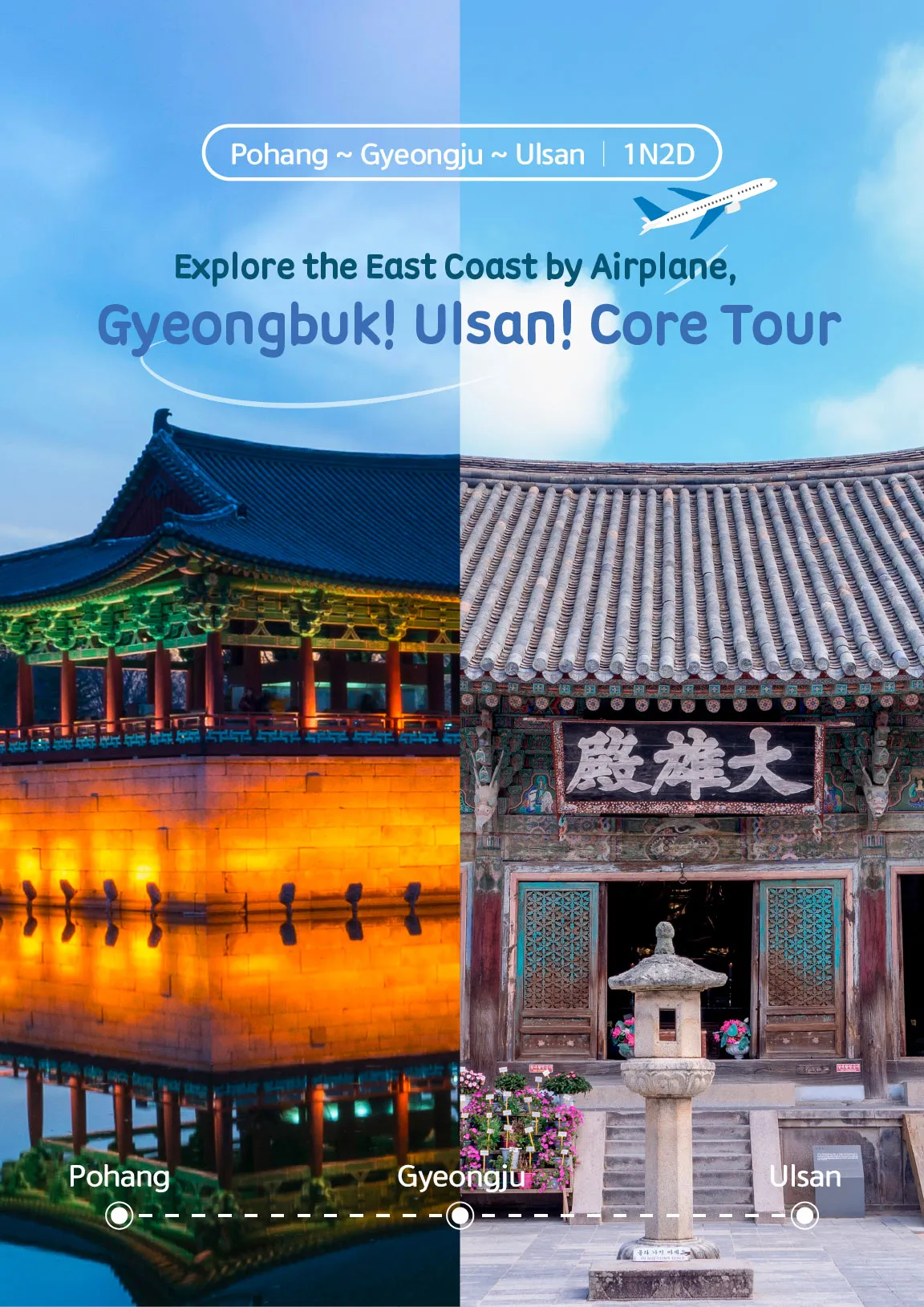
Explore the East Coast by Airplane, Gyeongbuk! Ulsan! Core Tour
Product Information
Explore the East Coast by Airplane, Gyeongbuk! Ulsan! Core Tour
Experience healing along Korea’s coast—Pohang, Gyeongju and Ulsan—where the beauty of Pohang, Gyeongju, and Ulsan meets rich history and seaside serenity.
🧾 Product Information
Traveler`s Type | Domestic, Foreigner |
Period of Travel | 1 night 2days |
Visiting Area | Pohang, Gyeongju, Ulsan |
Minimum No. of Applicants | Min 6 |
Remark | If the number of applicants does not meet the minimum number required, the tour could be canceled.Please note that reservations and cancellations for this product are subject to the Domestic Travel Special Conditions. |
Included |
|
Excluded | Other than included (Personal expenses etc.) |
※ The schedule below is subject to change in detailed programs and meal menus depending on local circumstances.
※ The program can be adjusted and changed according to the itinerary and duration of the trip.
Itinerary Overview
Day 1: Homigot Cape / DAY1 : Homigot Sunrise Square

Homigot Sunrise Square, located at Homigot Cape, is famous for its golden sunrise scenery and is one of the most popular places to watch the first sunrise of the New Year.
Homigot Sunrise Square at Homigot Cape is one of the most popular places for watching the New Year’s sunrise due to its brilliant yellow and golden sunrise scenery.
Day 1: Guryongpo Japanese House Street / DAY1 : Guryongpo Japanese House Street

Guryongpo Japanese House Street is where the Japanese who came to Joseon lived after the Joseon-Japan Trade Treaty was signed between Joseon and Japan in 1883. To remember the past pains and events, the city of Pohang preserved 47 wooden Japanese-style houses from the time and named the area "Guryongpo Japanese House Street." The Japanese house, which was used as a cooker at the time, is preserved in the form of an internal form and is currently operated as a teahouse, and it is possible to experience various tea and yukata in Japan.
Day 1: Yeonorang Seonyeo Theme Park, Guibigo / DAY1 : Yeono Lang Seo Sulwha Theme park ,Guibigo

guibigo is a new exhibition space with a variety of attractions by storytelling the Yeono Lang Seo Sulwha in Pohang area, providing Pohang citizens and tourists with the opportunity to imagine history and myths.
Day 1: Hwanho Park Space Walk / DAY1 : Hwanho Park Space Walk

This is a new landmark created in Pohang’s Hwanho Park, a structure symbolizing the identity of Pohang, the steel city. Hwanho Park Space Walk stretches 333m in total length, drawing an elegant curve toward the sky, and climbing along its 717 steps offers a wide-open panoramic view. From here you can see the blue sea, the sunrise and sunset over Yeongilman Bay, and at night, the dazzling night view of the Pohang Steelworks all at once.
This is the latest addition to Pohang’s Hwanho Park. Standing as the symbol of Pohang’s identity as a steel city, Hwanho Park Space Walk stretches 333 m in length toward the sky in a graceful arc. Follow the 717 steps to find a panoramic view of the area. One can see the blue seas, the sunrise and sunset at Yeongilman Bay, and the lights that brilliantly illuminate the Pohang Steel Plant at night.
Day 1: Donggung Palace and Wolji Pond (Night Tour) / DAY1 : Donggung Palace and Wolji Pond(Night Tour)

Donggung Palace was the residence of the crown prince of Silla, and Wolji Pond was the place where officials discussed state affairs or welcomed honored guests. Even a thousand years later, both places still retain the grandeur and beauty of the royal court, especially at night.
Donggung Palace was the palace in which the crown prince of Silla resided, and Wolji Pond was where the officials discussed the matters of the state or welcomed esteemed visitors to the kingdom. Even a millennium later, both places still retain their regal splendor and beauty, particularly at night.
Day 2: Bulguksa Temple, Seokguram Grotto / DAY2 : Bulguksa Temple and Seokguram Grotto


Bulguksa Temple, a UNESCO World Heritage Site, is one of the most iconic symbol of Korean Buddhism. It is home to numerous cultural heritages designated as National Treasure and Treasure of Korea, including Cheongungyo and Baegungyo Bridges, Dabotap and Seokgatap Pagodas, Stone Elevations of Bulguksa Temple, the Daeungjeon Hall, and stupa. From Bulguksa Temple, one can take a 20-min ride on shuttle buses departing every hour to reach the Seokguram Grotto at Tohamsan Mountain.
Day 2: Daereungwon Tomb Complex, Cheomseongdae Observatory, Woljeonggyo Bridge / DAY2 : Daereungwon Tomb Complex , Cheomseongdae Observatory, Woljeonggyo Bridge


Cheomseongdae Observatory is one of Gyeongju's representative historical landmarks, built during the reign of Queen Seondeok (r. 632–647). This observatory was built in a cylindrical shape and stands about 9 meters tall.
Woljeonggyo Bridge, located in Gyo-dong, Gyeongju, was built during the Unified Silla period (676–935) but was destroyed during the Joseon Dynasty. It was later restored based on historical research and rebuilt in April 2018, and is now known as the largest wooden bridge in Korea.
Gyeongju Daereungwon Tomb Complex consists of five tombs, Ancient Tombs of Gyeongju. Within Daereungwon Tomb Complex is Cheonmachong Tomb, which was excavated in 1973. Furthermore, Hwangnamdaechong Tomb was excavated between 1973 and 1975, and is a set of twin tombs belonging to a presumed married couple.
Cheomseongdae Observatory, constructed during the reign of Queen Seondeok (r. 632-647), is one of the landmarks of Gyeongju. The observatory was built in a cylinder shape at approximately 9 meters in height.
Woljeonggyo Bridge, located in Gyo-dong, Gyeongju, was built during the Unified Silla period (AD 676-935), but was burnt down during the Joseon dynasty. Through historical research, the bridge was rebuilt in April 2018 to become the largest wooden bridge in Korea.
Day 2: Jangsaengpo Whale Culture Village / DAY2 : Jangsaengpo Whale Culture Village

Opened in 2015, Jangsaengpo Whale Culture Village reproduces the scene of an old whaling village through areas like Whale Plaza, Jangsaengpo Old Village, Prehistoric Whale Experience Garden, an aquatic botanical garden and other themed area as well as a sculpture park. You can take the monorail to enjoy a panoramic view of the Whale Culture Village, the coast of Jangsaengpo, Ulsan Bridge, and the Ulsan Industrial Complex all at once.
Select Date
- Select date
Select Option
- Total Price US$0.00