

 Sign in
 Search

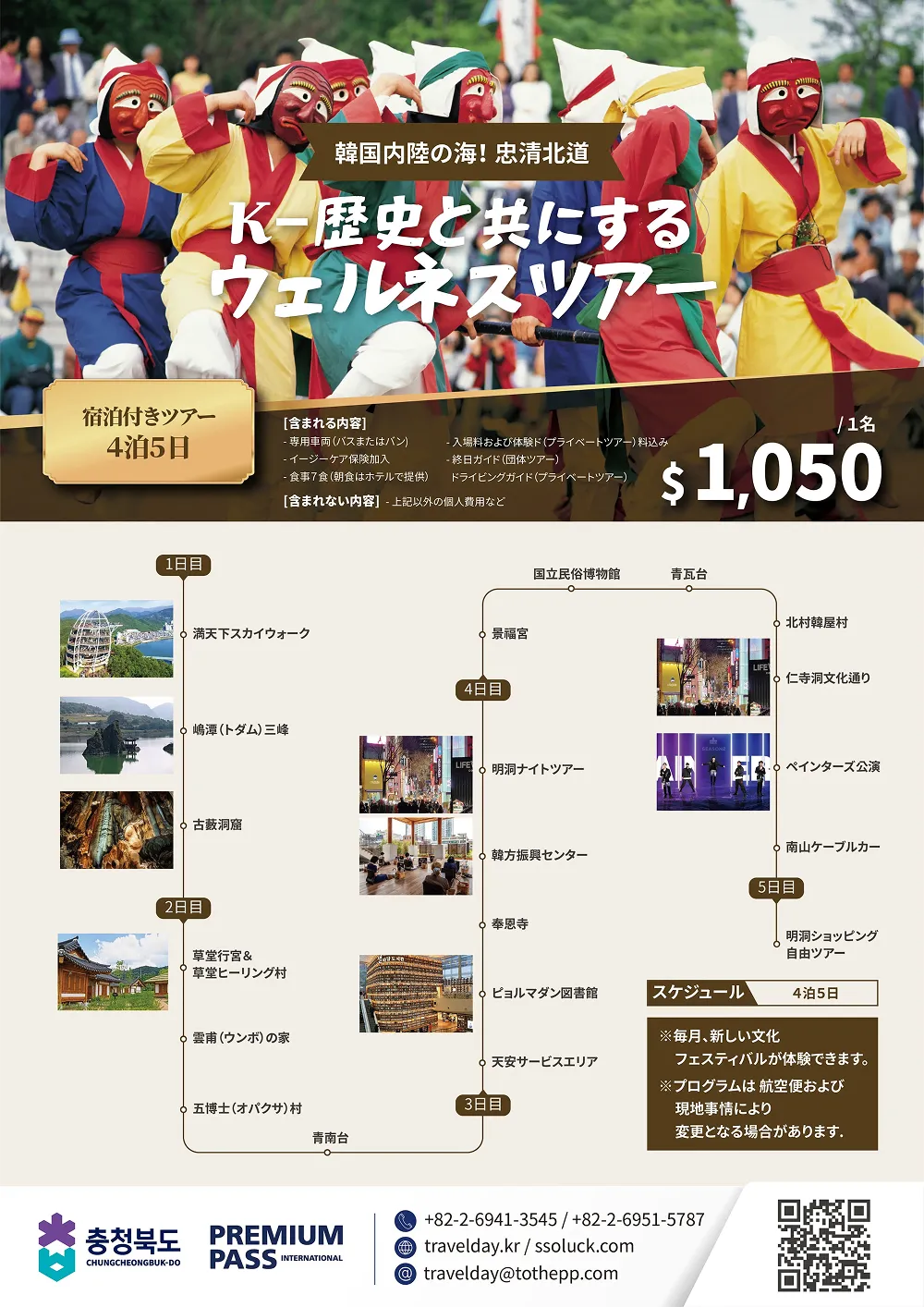
4 Nights 5 Days Wellness Tour with K-History
Product Information
K-History Wellness Tour 5 Days 4 Nights
Experience the Rich Cultural Content of Chungbuk!
Product Information
Traveler Type | Domestic/Foreign |
|---|---|
Travel Duration | Day Tour |
Travel City | Seoul-Danyang-Cheongju-Seoul |
Number of Reservations | Minimum 6 people for departure |
Precautions | If the number of reservations is less than the minimum required for departure, the tour may be canceled. Please note that the reservation and cancellation of this product are subject to the special terms and conditions for domestic travel. |
Inclusions |
|
Exclusions | Other than inclusions - personal expenses, etc. |
Itinerary
Product Itinerary | ||||
|---|---|---|---|---|
Time | Destination | Remarks | ||
Transfer (Seoul → Danyang) | *Hotel departure available | |||
Meet Danyang's spectacular scenery [Manchunha Skywalk] | ||||
The best of Danyang's Eight Scenic Views [Dodam Sambong] | ||||
A natural limestone cave formed over 450 million years [Gosu Cave] | ||||
Transfer (Danyang → Cheongju) | ||||
Dinner | ||||
Hotel check-in and rest | ||||
Transfer (Hotel → Chojeong Haenggung) | ||||
One of the world's three great mineral springs that captivated King Sejong [Chojeong Haenggung and Chojeong Healing Village] | Mineral spring spa experience | |||
K-drama "Mr. Sunshine filming location" [Unbo's House] | ||||
Rural experience resort village [Dr. Oh's Village] | Making traditional (folk) masks and learning mask dance | |||
The President's Secret Garden [Cheongnamdae] | ||||
Dinner | Cheongnamdae Todamgol | |||
Hotel check-in and rest | ||||
Transfer (Cheongju→Seoul) | ||||
K-Local Food experience (walnut cookies) [Cheonan Rest Area] | ||||
Gangnam's hot spot complex cultural space [Byeolmadang Library] | ||||
Lunch | Jeju Abalone Jeju food specialty restaurant | |||
A thousand-year-old temple in the heart of the city [Bongeunsa Temple] | ||||
Meeting with traditional Korean medicine [Korean Medicine Promotion Center] | Korean medicine foot bath experience | |||
Hotel check-in and rest Free night tour of glamorous Myeongdong | ||||
Transfer (Hotel→ Gyeongbokgung) | ||||
Joseon Dynasty's premier main palace & Royal Guard Changing Ceremony [Gyeongbokgung Palace] | ||||
A glimpse into Korean history and culture [National Folk Museum] | ||||
The President's Residence [Cheong Wa Dae (including Sarangchae)] | ||||
Lunch | ||||
Where tradition and modernity coexist [Bukchon Hanok Village] | ||||
Center of Korean traditional culture [Insadong Culture Street] | ||||
Early dinner | ||||
Fusion of performance and art [Painters Performance] | ||||
Enjoy Seoul's night view [Namsan Cable Car] | Hotel check-in and rest | |||
After hotel check-out [Myeongdong Shopping Free Tour] | ||||
Arrival at airport, departure procedures and departure | ||||
Itinerary Introduction
Manchunha Skywalk
A skywalk where you can experience the thrill of walking a sky path while looking down 80-90m below the water surface from atop a cliff on the Namhan River,
offering views of the city skyline and Yeonhwabong Peak of Sobaeksan Mountain in the distance.
At the horseshoe-shaped Manhakcheonbong Observatory, experience the thrill of walking at the edge of the cliff through a three-finger-shaped, high-strength triple-layered glass path that is 15m long and 2m wide,
looking down at the Namhan River flowing beneath your feet!
The Manchunha Skywalk observatory, built 25m high, 80-90m above the surface of the Namhan River, allows you
to experience walking while looking down at the river about 100 meters below your feet.
See the Namhan River at a glance, feel the thrill of walking the sky path above the Namhan River! Take in the beautiful scenery of the Namhan River at a glance
Experience thrilling fun and excitement all at once at Manchunha Skywalk!

Dodam Sambong
An island of three peaks in the middle of the upper reaches of the Namhan River in Danyang-gun, Chungcheongbuk-do. It is one of Danyang's Eight Scenic Views, and was designated as Scenic Site No. 44 on September 9, 2008. The peaks rising above the water form a beautiful and unique view, making it a popular tourist destination. It is the most frequently mentioned among Danyang's Eight Scenic Views. The tallest central peak is called Janggunbong, the northern peak is called Cheobong, and the southern peak is called Cheopbong. It is famous as a hotspot for photographers.

Gosu Cave (Natural Monument)
500 million years of time created a mysterious underground palace
Located at 8 Gosudonggul-gil, Danyang-eup, Danyang-gun, Chungbuk, Danyang Gosu Cave (Natural Monument) is one of the most mysterious and beautiful natural caves. Inside the 1,700m-long cave, there are various attractions including stalactites, stalagmites, cave coral, cave pearls, natural bridges, and the rare stalactite mineral aragonite.


Chojeong Haenggung and Chojeong Healing Village
One of the world's three great mineral springs that captivated King Sejong
It is a temporary palace built and stayed at by King Sejong to treat eye diseases and other illnesses
. It was built in January 1444 (26th year of King Sejong's reign), and it was here that Sejong later completed the creation of Hangul while staying
Experience 1) Mineral spring spa with excellent effects on skin treatment


Unbo's House
A place where you can meet the life and works of painter Kim Ki-chang, and feel the history and quiet elegance of the old house
It became even more famous as the filming location for the drama Mr. Sunshine


Rural experience resort village [Dr. Oh's Village]
Dr. Oh's Village is a village of scholars, an eco-friendly rural experience education center and resort village with a 350-year tradition, and it is a village that continuously attracts the love of many visitors every year
Experience 1) Making traditional masks
Experience 2) Wearing the traditional mask you made and learning mask dance from an expert

Cheongnamdae
It is a villa that was used exclusively by the President of the Republic of Korea
Construction of Cheongnamdae began in June 1983, during the administration of Chun Doo-hwan, and was completed in December of the same year. For 20 years after opening, it was a place where five presidents—Chun Doo-hwan, Roh Tae-woo, Kim Young-sam, Kim Dae-jung, and Roh Moo-hyun—rested and planned state affairs.
Originally named "Yeongchunjae (迎春齋)," meaning "house welcoming spring," it was renamed Cheongnamdae in 1986, meaning "the Blue House of the south." It has been used since the Fifth Republic era, and was opened to the public on April 18, 2003, during the Participatory Government. Since then, it has attracted over 8 million visitors in 11 years, establishing itself as a popular presidential-themed tourist destination.

Cheonan Rest Area Walnut Cookie Experience
Enjoy the process and taste of making cookies using Cheonan's specialty walnuts

Byeolmadang Library
The meaning of "Byeolmadang Library" combines "Byeol (star)," symbolizing dreams taking flight, and "Madang (yard)," symbolizing an open space that anyone can use for free. With the meaning of "a space where you can open a book and embrace your dreams," anyone can use it for free

Bongeunsa Temple
As it was the royal tomb temple of Seonjeongneung, it has been well preserved and is famous as a rare ancient temple in the heart of the city. Above all, its advantage is that it is easily accessible, unlike other mountain temples, as it is located in the middle of Gangnam. Bongeunsa Temple, surrounded by urban forest, is a great place to feel nature. In particular, there are not many temples of this size that are directly accessible from the city center without hiking. Moreover, Bongeunsa is located in the middle of Gangnam, arguably the busiest area in Korea, yet it becomes remarkably quiet once you step inside.


Korean Medicine Promotion Center
To the east, Bojewon was a relief institution that provided medicine and aid to the common people living near Hanyang, and
this center was established on that very site
A meeting with traditional Korean medicine, experience healing with your whole body through Korean medicine
Experience 1) Korean medicine foot bath experience: dip your feet in a footbath containing Korean medicinal herbs to remove toxins


Gyeongbokgung Palace
Gyeongbokgung Palace (景福宮) is the premier main palace (法宮) of the Joseon Dynasty
built in 1395 (4th year of King Taejo's reign), after the founding of the Joseon Dynasty in 1392
Gyeongbokgung Palace's buildings were arranged across a wide area with Mt. Baegak (Bukhansan) as its main mountain, and it was the center of Hanyang, with the wide Yukjo Street extending in front of Gwanghwamun, the main gate.
The name "Gyeongbok" contains the meaning that "the new dynasty will enjoy great fortune and prosper," and
it was here that Hunminjeongeum (Hangul) was created and proclaimed during the reign of King Sejong.


National Folk Museum
It is a national museum under the Ministry of Culture, Sports and Tourism
established for the collection, preservation, and exhibition of unique folk materials and related systematic research and investigation

Cheong Wa Dae (including Sarangchae)
Cheong Wa Dae (靑瓦臺), also known as the Blue House, was a facility used as the office and residence of the President of the Republic of Korea, and its Yeongbinguan (state guest house) and Sangchunjae are still used for practical purposes. It is located at 1 Cheongwadae-ro (Sejong-ro), Jongno-gu, Seoul.
From the Syngman Rhee administration to the Moon Jae-in administration since liberation, Cheong Wa Dae served as the Presidential Palace (大統領宮), functioning both as the presidential office where the President of the Republic of Korea carried out official duties and as the presidential residence where they lived after work, as well as the administrative body, the Office of the President (大統領府), where staff and public officials assisting the constitutionally established President worked.

(Fully opened to the public in May 2022)

Bukchon Hanok Village
The most Korean-style alley, Bukchon Hanok Village
Bukchon Hanok Village has been home to the yangban (aristocratic) class since 600 years ago, and residents still actually live there today, preserving the hanok village. Bukchon Hanok Village retains important historical assets, and it is considered an attractive tourist destination with many streets showcasing the beauty of hanok.

Insadong Culture Street
Insadong is still one of Seoul's representative streets. It is the street most visited by foreign tourists, and it is a neighborhood where tradition runs so deep that even the Starbucks sign has been changed to Hangul. Antique shops have been concentrated in Insadong since the end of the Japanese colonial period, so the history of the antique street alone spans well over half a century. Today, Insadong Street is home to numerous galleries and art spaces centered around antique shops. And inside the alleys are lined with traditional restaurants. In recent years, new and old attractions such as Ssamziegil, Gana Art Space, Kyunginmisulkwan, Mokin Museum, and the Beautiful Tea Museum have harmonized to create a new landscape.


Painters
A one-of-a-kind, magical art performance!
THE PAINTERS Season 2 is a performance that dramatically portrays the process of creating a work of art through the creative fusion of amazing live drawing, sensual urban dance, and media art.

Namsan Cable Car
The Namsan Cable Car is a facility that allows you to ascend from Hoehyeon-dong to the summit of Namsan while taking in a panoramic view of Seoul. It began operation on May 12, 1962, and continues its history to this day. The distance the cable car travels is about 600m from the Hoehyeon-dong station to the Yejang-dong station at the top of Namsan. The cable car operates at an average speed of 3.2m per second, and the one-way trip takes about 3 minutes. The height difference from the ground is about 138m.

Myeongdong
Myeongdong, which was once the center of modern and contemporary Seoul culture and finance, has now established itself as Korea's largest commercial district and a representative special tourism zone serving as a center for tourism and shopping.


Select Date
Number of Travelers
0
- Total Price $0.00